Load Shedding is Still a Real Problem in Bangladesh
When electricity goes out during a hot summer day or night, comfort disappears immediately. Fans stop, rooms heat up quickly, and sleeping becomes difficult—especially for children and elderly family members.
In Bangladesh, load shedding is not the same everywhere:
Urban areas: typically 2–4 hours
Rural areas: often 6–12 hours or more
Because of this difference, a single “one-size-fits-all” solar system does not work for everyone.
The Most Common Mistake People Make
Most people start by asking:
“How much will it cost to run 2 fans and 2 lights?”
While that is an important question, the next question is:
“How many hours of backup do I need?”
Because a system designed for 3 hours and one designed for 12 hours are completely different.
Another common mistake is buying components separately:
Battery from one seller
Inverter from another
Solar panels later
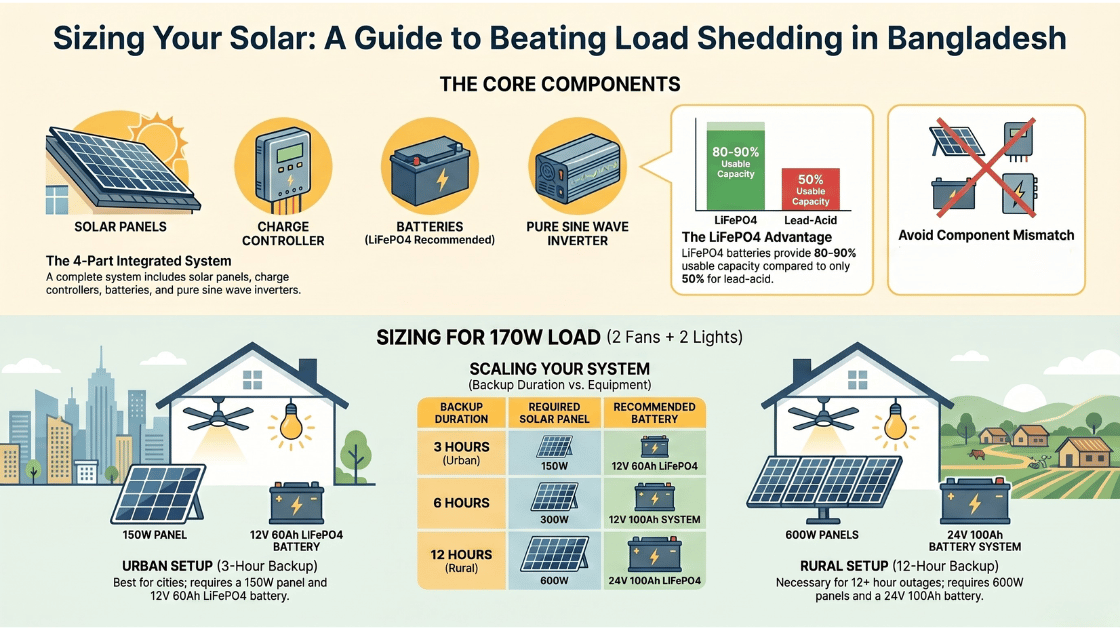
This often leads to poor system performance due to mismatch between components.
What a Complete Solar System Includes
A proper home solar system is not a single product. It consists of four main components:
1. Solar Panels
Convert sunlight into electricity and charge the battery during the day.
2. Charge Controller (MPPT / PWM)
Controls power flow between solar panels and battery.
PWM: basic and budget-friendly
MPPT: more efficient, faster, and more stable charging
👉 In real-world systems, MPPT performs significantly better.
3. Battery (Energy Storage)
This is what powers your home during load shedding.
👉 We recommend LiFePO4 (EVE cells) because:
Longer lifespan
Higher usable capacity
Faster charging
Safer and more stable performance
4. Pure Sine Wave Inverter
Converts DC power from the battery into AC power for household appliances.
Runs fans, lights, TV, router, etc.
Safe for sensitive electronics
How to Size a Solar System (Real Example)
Let’s take the most common household load:
2 Fans + 2 Lights
1 ceiling fan ≈ 75W
2 fans ≈ 150W
2 LED lights ≈ 20W
👉 Total load ≈ 170W
System Design Based on Backup Time
✅ Scenario 1: 3 Hours Backup (Urban Areas)
Energy required: ~500Wh
Recommended system:
Battery: 12V 60Ah LiFePO4
Inverter: 500W(continuous) pure sine wave
Solar panel: 150W
Charge controller : 20A PWM
✅ Scenario 2: 6 Hours Backup
Energy required: ~1000Wh
Recommended system:
Battery: 12V 100Ah system
Inverter: 500W(continuous) pure sine wave
Solar panel: 300W
✅ Scenario 3: 12 Hour Backup (Rural Areas)
Energy required: ~2000Wh
Recommended system:
Battery: 24V 100Ah LiFePO4
Inverter: 500W(continuous) pure sine wave
Solar panel: 600W
Why LiFePO4 Batteries Matter
Real usable capacity is very different between battery types:
Lead-acid batteries → ~50% usable capacity
LiFePO4 batteries → ~80–90% usable capacity
This means LiFePO4 batteries deliver more usable energy, last longer, and are more cost-effective in the long run—even if the upfront price is higher.
What Customers Actually Do (Real Experience)
Many customers start with a simple requirement:
“I only need to run 2 fans and 2 lights.”
But later they often add:
WiFi router
TV
Small water pump
This is why system design should always consider future expansion, not just immediate needs.
Solar Is Not Just a Product — It’s Comfort
Most people do not buy solar batteries and inverters because they enjoy equipment.
They buy them for:
Comfort during load shedding
Sleep during hot nights
Stability for their family
That’s why correct system design matters more than just buying parts.
Final Thoughts
Before buying a solar system, ask yourself:
What appliances do I actually want to run?
How many hours of backup do I need?
What is the typical load shedding duration in my area?
Once you have these answers, selecting the right system becomes much easier—and you avoid costly mistakes.
A properly designed solar system is not just about electricity. It is about ensuring comfort and peace of mind for your family when the grid fails.